
General Notice
This is a prototype report for the course ARI2131 “Artificial Intelligence in Education” of the winter term 2024/25 at the University of Malta.
The report is authored by Ludwig Lorenz, erasmus exchange student with the student number 2417196 and licensed under CC-BY-SA 4.0.
The accelerated increase of available media and an economic shift towards information technology let historians coin a phrase for the recent decades: Information Age. 1 The stone, copper and iron age were named after the material from which it’s most influential tools were made of. What, then, is the transformative tool of our time, that is crafted from information?
The world wide web is one obvious answer. Started as a distributed storage for research, it became an interactive digital resource and economic platform. It is a great example of a tool that allows multiple parties, ranging from individuals to institutions, to collectively aggregate information and make it accessible. Next to this public information network, personal networks of knowledge emerged.
A Personal Knowledge Base (PKB) represents a contemporary approach to managing and enhancing individual knowledge and information. In essence, a PKB is a, most commonly digital, repository that individuals use to collect, organize, and retrieve information relevant to their personal lives. This concept is not entirely new; rather, it has evolved in response to the changing dynamics of information consumption in the digital age. Historically, individuals have employed various methods to document and organize their knowledge. From commonplace notebooks and journals to more sophisticated personal libraries, people have sought ways to retain information for future reference. With the emergence of digital technology more radical approaches to personal knowledge management were introduced. The Memex, conceptualized in 1945 by Vannevar Bush, was a hypothetical personal knowledge device that allowed a user to link knowledge records similar to a hypertext system. From 1952 until 1997 the German sociologist Niklas Luhmann collected his knowledge written on little cards in drawers called a “Zettelkasten” that he manually linked with each other.
With over 90,000 cards it remains a mystery how Luhmann was able to recall the already existing cards when linking them to a new one. Luhmann (1981) explained that the “Zettelkasten” is not only a knowledge archive but instead an active tool of thought. It is worth to note that while Luhmann focused on the management of knowledge, others had a broader scope. The American system theorist R. Buckminster Fuller attempted to document his life as thorough as possible by collecting correspondence, bills, notes and sketches from 1917 to 1983. The collection, named “Dymaxion Chronofile’’ (Li, Dey, and Forlizzi 2010) , contains over 140,000 pieces of paper.
Those extensive examples of Knowledge Management are passion projects of pioneers, while the emergence of digital technology has significantly transformed these practices, giving rise to the modern concept of Personal Knowledge Bases and making it more accessible and usable to everyone.
Methods for personal knowledge management evolved. Advanced note taking software like “Obsidian.md’’ allows users to manage a”Zettelkasten’’-like Personal Knowledge Base by indexing, memorizing the existing notes and back-linking notes for them. With the exponential growth of online content, individuals find themselves overwhelmed with information from diverse sources. From the learners perspective, Personal Knowledge Bases offer a central platform for the aggregation and organization of information scattered across different platforms, apps, and devices. As more and more information sources develop, individuals also face difficulties in recalling and connecting relevant pieces of knowledge. PKBs serve as a cognitive aid, helping individuals structure and categorize information according to their unique needs. While curating information that aligns with their specific needs and preferences, users may also be able to improve their own learning and recall ability and opening up the possibilities of life long learning.
When your note helps you rediscover knowledge and make links to previous experience should your notebook receive credit for this cognitive process? The Extended Mind theory Clark and Chalmers (1998) challenges the traditional notion of the mind as being confined to the boundaries of the skull, suggesting that cognitive processes can extend beyond the brain and include external tools and artifacts. Personal Knowledge Bases form a coupled system with it’s user and act as an external repository for information and knowledge offloading cognitive processes to external objects. The integration of digital tools, such as note-taking apps, calendars, and web archives, into the cognitive workflow allows individuals to access information beyond what is stored in their biological memory. This suggests that our cognitive abilities are depended on the tools we use, and the boundary between internal and external cognitive processes becomes blurred. Further, emerging technologies like machine learning on personal information open up the question if not only the access of information but even the creation of knowledge can be offloaded.

Experiments like #IAN, a fine-tuned large language model trained on a personal knowledge base show how such systems can be aware of the users experience and the context of the current mental process connected to the note. It was created by Jan Kirchner in August, 2021. 2 One year later, in November 2022, the commercial knowledge management platform Notion introduced their AI assistant which generates responses partially based on the content present in the knowledge base. Kirchner explained how he was inspired by Holden Karnodsky’s idea to imagine yourself as a digital person. Instead of delegating responsibilities and tasks to others instead they are given to a deployed digital version of yourself in a computer.
By linking personal knowledge bases to the Extended Mind theory, one can view these external information systems as integral components of an individual’s cognitive system. Siemens (2004) comes to a similar conclusion in a definition for learning in his theory of connectivism.
Learning (defined as actionable knowledge) can reside outside of ourselves (within an organization or a database), is focused on connecting specialized information sets, and the connections that enable us to learn more are more important than our current state of knowing.
Source: Siemens (2004)
This also infers that a removal or constraint on access to a personal knowledge base damages one mental abilities. Those mental abilities are then also dependent on how accurately the knowledge base represents the digital self. In awareness of the before mentioned technologies it seems promising to combine Buckminster Fuller’s scope in personal information collection with Niklas Luhmann’s approach of connected personal knowledge management. In explanation, the digital traces that we leave behind in our everyday interactions can form a mental frame to improve the recording and linking of ideas and knowledge for learners.
Montoya et al. (2016) extends the PKB definition by implementing a framework to integrate recorded personal data to the knowledge base. It is reasoned, that not only information but also personal knowledge is spread over emails, messages, contact lists, calendars, location history, and many other types of data. While commercial systems unfold as data traps, more efforts to self-recording personal data were adressed by the life logging movement. In that context, Li, Dey, and Forlizzi (2010) proposed the notion of personal informatics systems as those that help people collect personally relevant information for the purpose of self-reflection and gaining self-knowledge. This describes a feedback loop between user and system. The system tracks the action of the user and thereby helps the user to reflect on short-term and long-term goals. The identification of goals from recorded data is a relevant computational aspect.
For the scope of this prototype, two AI applications for personal knowledge spaces are investigated in detail.
A collaborative knowledge management tool that stores your notes online in the cloud and calls itself an “Everything App” is Notion. In 2022, several AI-based features for the tool were introduced as Notion AI. Those features has evolved substantially, with its 2024 update introducing third-party integration capabilities expand its knowledge access beyond the notes stored in Notion. The system now seamlessly integrates multiple external platforms such as Slack and Google Drive through its connector beta program.
Introducing Notion AI - YouTube
Notion AI’s content generation and manipulation capabilities are deeply integrated into the workspace environment. Users can interact with the AI through intuitive interfaces, either by highlighting existing text or utilizing the space command within any page. This integration enables a wide range of content-focused operations that can be broadly categorized into three main functional areas: Page-Level Modifications including automated summarization and multilingual translation features. Contextual Content Editing provides granular control over content refinement, such as grammar correction, content length adjustment, and tone modification. Creative Content Generation creates structured content such as outlines, email drafts, and tables, as well as it allows users to engage in AI-assisted brainstorming. These generation features are enhanced by the system’s ability to incorporate contextual information from the user’s notes. From the documentation it is not clear how this was achieved technically. More transparent than Notion is an open source plugin created for the local knowledge management tool Obsidian.md.
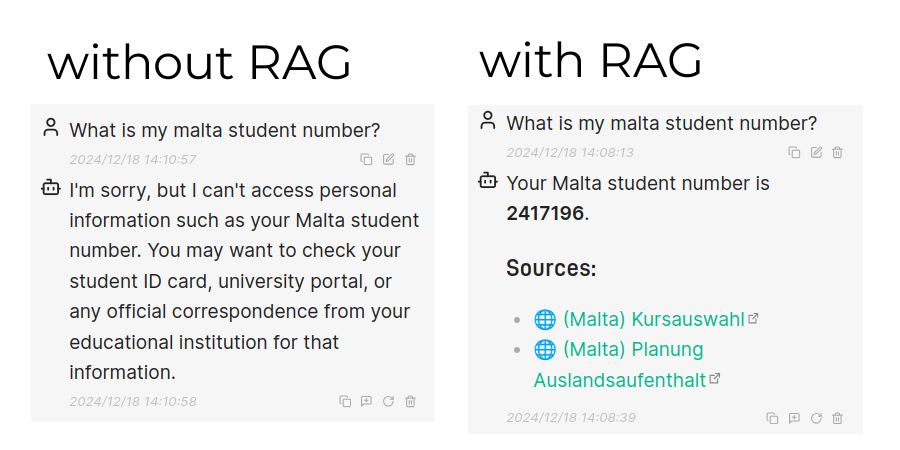
The Obsidian Copilot plugin, released in 2023 as an open-source third party project for the Obsidian note-taking application, represents a practical implementation of vector-based knowledge retrieval in personal knowledge bases. At its core, the plugin employs the OpenAI API to create and maintain a local vector index database of the user’s personal knowledge base. This approach ensures that the semantic information from notes remains accessible locally and only information relevant to the request is exposed to the language model.
The system’s query process follows a two-stage architecture. First, when a user poses a question, the system searches against the local vector index database to identify relevant notes. In the second stage, these contextually relevant notes are attached to the query before it is sent to the OpenAI API. This architecture effectively implements a retrieval-augmented generation approach, allowing the language model to provide responses that are grounded in the user’s personal knowledge context. A similar structure is adopted for the prototype idea.
Through examining the current landscape of AI applications for personal knowleg bases, I have identified a significant gap. While existing applications focus on content retrieval and generation, they largely overlook the critical challenge of establishing meaningful conceptual connections between notes. This unexplored problem space presents an opportunity for innovation in how we approach knowledge organization and discovery.
To illustrate the practical application of my proposed solution,
consider a scenario where a user listening to a lecture adds a new note
about the theory of contextual integrity, a privacy framework developed
by Helen Nissenbaum. The Personal Knowledge Connector would
then activate to establish meaningful connections within the user’s
existing knowledge base. This would quickly expose aware and unaware
connections of the new concept to previous knowledge of the user. With
the learning theory of connectivism in mind, this can support the user
in learning about the new concept unlike any other digital tools because
they lack access to the user’s private knowledge.
In developing this system, I have identified two primary subproblems
that require distinct solutions. The first challenge concerns
establishing adequate semantic context for concept notes. Through
experimental verification, which is explained in detail in the chapter
on Semantic Embedding, I have found that note titles alone, such as
“Contextual Integrity”, provide insufficient information for
effective semantic embedding. To address this limitation, I propose
Component A: the Texbook Engine, which generates
comprehensive summaries and encyclopedic textbook-style entries for each
concept using large language models.
The second subproblem involves identifying semantically similar notes
within the knowledge base. To tackle this, I have designed Component B:
the Knowledge Connector, which implements a multi-step
process for establishing meaningful connections. This component first
generates embedding vectors for each note in the knowledge base. It then
calculates cosine similarity between the current note and all other
notes, producing a ranked list based on semantic similarity. Finally, it
employs a language model to characterize the specific relationships
between the current note and the most semantically similar entries,
providing context for these connections.
Through this dual-component approach, I aim to create a system that not only understands the semantic content of individual notes but also establishes meaningful connections that enhance the user’s ability to navigate and understand their personal knowledge base.
The first component implements an automated approach for generating
additional information to a new note through the integration of large
language models (LLMs) and structured data extraction. The
Textbook Engine consists of three main steps: (1) natural
language generation of encyclopedic entries, (2) automated metadata
extraction and classification, and (3) linking.
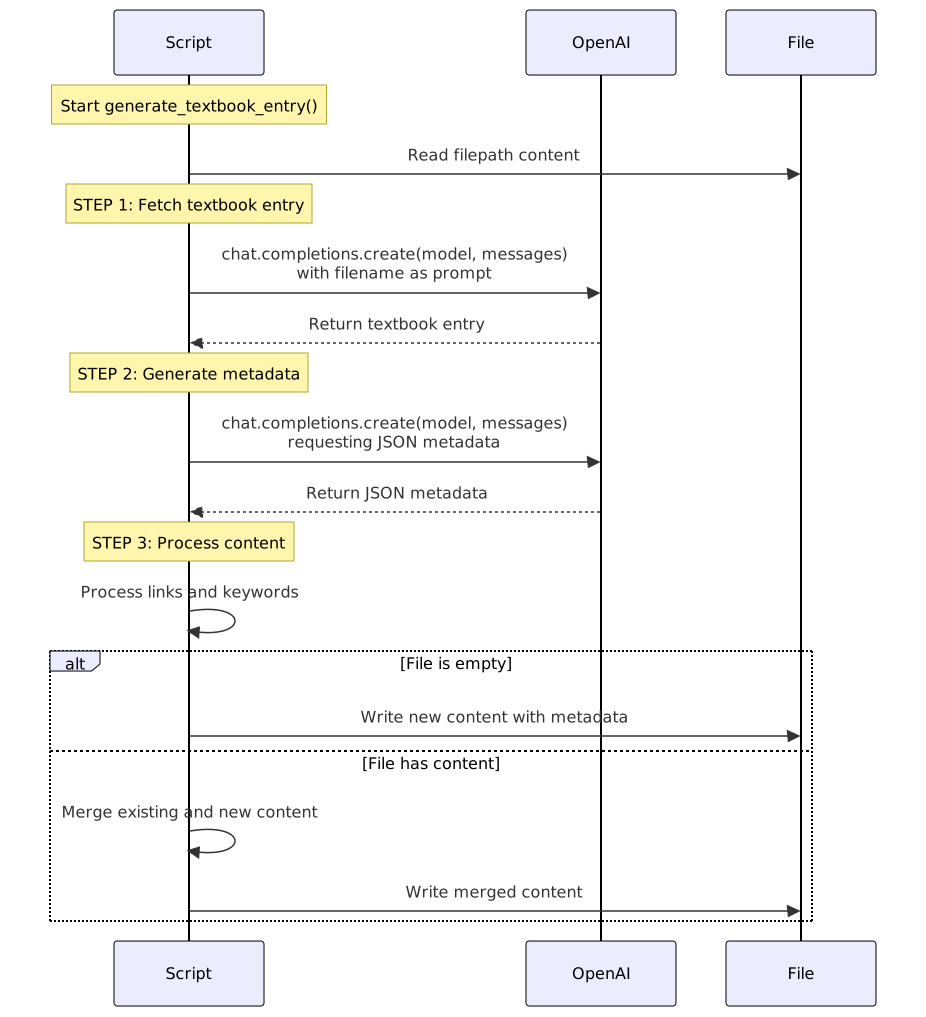
The system employs a two-pass approach using LLMs. In the first pass, given the name of the new note such as “Contextual Integrity”, the model generates a comprehensive encyclopedic entry following a standardized format consisting of an introductory sentence followed by key points or tabulated information. This unstructured content is generated using a custom prompt that encourages concise yet informative descriptions suitable for knowledge base integration.
The second pass processes this initial content through a structured data extraction pipeline. The system automatically generates metadata including classification of the note’s central concept (e.g., person, concept, event), domain categorization, keyword extraction, and alias identification. This metadata is encoded using the Pydantic data validation framework, ensuring type safety and consistent data structures. The metadata schema includes:
The generated content undergoes automated processing to establish links within the knowledge base. The system identifies mentions of other entities within the generated content and creates markdown-based hyperlinks, effectively forming a navigable knowledge graph.
The final output combines structured frontmatter metadata in YAML format with markdown-formatted content, creating a hybrid document structure that is both machine-readable and human-friendly. This hybrid approach enables integration with existing knowledge management systems like Obsidian. Obsidian is able to visualize such links as a graph. The extracted domain and the type is used as tags for the note that can be visualized with a color feature.
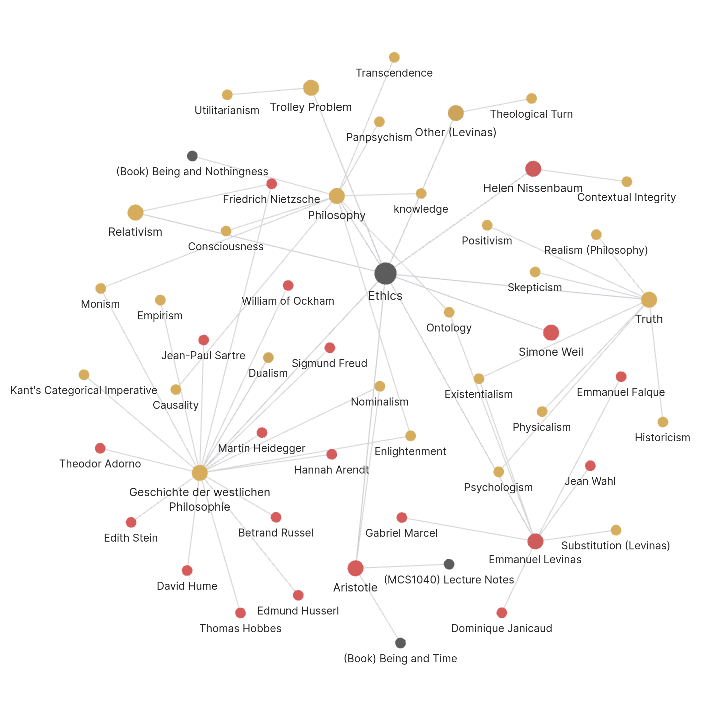
This video demonstrates how the Texbook Engine is used
to generate information for a note on the “Mind-Body Problem”. The
script is triggered through the keyboard combination
Strg + G. On the left side the note is shown. At the top of
the note the extracted metadata is displayed. The generated textbook
entry is put into a special callout to clearly separated artificially
generated content from personal notes. Links to existing notes begin
with a 🌱 seedling emoji. Linked keywords without a note begin with a 🟣
purple circle emoji. The right side shows the knowledge graph for the
note. After executing the script in the background the knowledge graphs
evolves showing the links in the note.
The second component implements the Knowledge Connector
which connects a note based on the semantic similarity to other notes in
the knowledge base.
Semantic embedding is a technique in natural language processing where words, sentences, or even entire documents are mapped into a high-dimensional continuous vector space such that their geometric relationships reflect semantic similarities. (Mikolov 2013) One important result of this is that documents that are semantically related are geometrically closer to each other than more unrelated documents. Models like Word2Vec, GloVe, and FastText generate word embeddings, while transformer-based approaches like BERT and Sentence-BERT extend this concept to contextualized sentence or paragraph embeddings. For this prototype a paragraph embedding is employed. Via an OpenAI API request for each note, embedding vectors from the text-embedding-3-small model are generated and locally stored. \[ \cos(\theta) = \frac{\mathbf{a} \cdot \mathbf{b}}{\|\mathbf{a}\| \|\mathbf{b}\|} \] The cosine similarity is chosen as the metric for calculating the semantic similarity between the embedding vectors \(\mathbf{a}\) and \(\mathbf{b}\). With this metric a ranking of the five most semantically similar notes is produced. The prototype is based on the naive assumption that the most similar notes are also relevant. It is important to mention that also notes with low semantic similarity can be relevant. These notes are currently overlooked by the prototype.
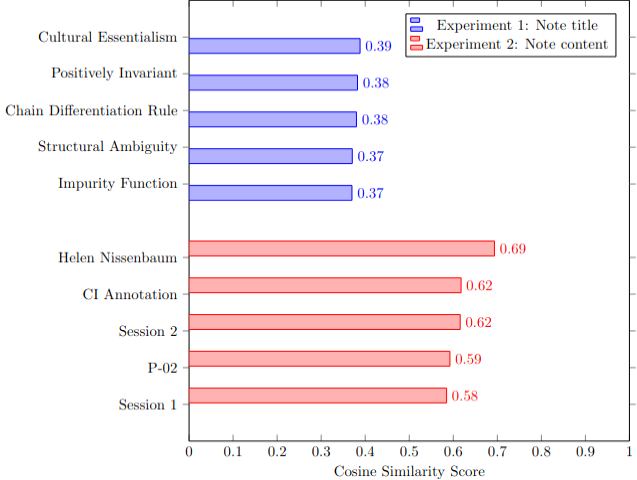
In my experimental investigation of embedding strategies, I compared two distinct approaches for generating semantic representations: title-only embedding and full-content embedding. The analysis revealed significant differences in both the quantitative similarity metrics and the qualitative relevance of connections established.
When employing title-only embedding, I observed substantially diminished performance. Similarity rates were approximately half of those achieved with full-content embedding, indicating a significant loss of semantic information. More critically, qualitative analysis of the top five most similar notes revealed negligible to weak semantic connections with the target concept of “Contextual Integrity.” This suggests that title-based embedding fails to capture the essential conceptual relationships necessary for meaningful knowledge linking.
In contrast, full-content embedding demonstrated superior performance, with similarity rates nearly double those of the title-only approach. The titles of the most similar notes did not necessarily indicate obvious semantic connections. This highlights the complexity of relying on surface-level metadata. The effectiveness of this approach was particularly evident in the results, where the highest-ranking note pertained to Helen Nissenbaum, the philosopher who developed the concept of contextual integrity. Additionally, other high-ranking notes were derived from my attendance at a conference focused on contextual integrity in 2022, demonstrating the system’s ability to identify genuinely relevant semantic connections.
Based on these experimental findings, I conclude that successful
semantic linking requires enhanced contextual information prior to
similarity calculations. The performance difference between title-only
and full-content embedding emphasizes the necessity of enriching notes
with additional semantic context before attempting to establish
meaningful connections within the knowledge base. This insight caused
the development of the Texbook Engine component in my
system architecture.
The integration of AI technologies with personal knowledge management systems raises significant privacy and ethical concerns. This chapter focuses on 1) legal consideration based on the privacy risks and 2) meta-cognitive ethical consideration based on cognitive biases.
The prototype in connection with a personal knowledge base raises privacy concerns, particularly within the framework of the General Data Protection Regulation (GDPR). I have identified two critical dimensions of privacy considerations that require careful examination.
The first dimension concerns the protection of users’ personal data, as defined in Article 4 (1) of the GDPR:
‘Personal data’ means any information relating to an identified or identifiable natural person (‘data subject’); an identifiable natural person is one who can be identified, directly or indirectly, in particular by reference to an identifier such as a name, an identification number, location data, an online identifier or to one or more factors specific to the physical, physiological, genetic, mental, economic, cultural or social identity of that natural person;
Source: Art. 4 (1) GDPR – Definitions - General Data Protection Regulation (GDPR)
A fundamental challenge emerges from connected knowledge graphs: their flexibility and interconnectedness make it virtually impossible to predict the types and extent of personal information that users might incorporate into the system. This unpredictability creates significant challenges for implementing appropriate privacy safeguards and ensuring GDPR compliance. One solution could lie in the framework of Contextual Integrity as described by Nissenbaum (2004) . The core idea is to assess the context of the information before further processing. For the scope of this prototype a contextual integrity component could assess the context of the most similar notes. Only if the context aligns with the context of the initial note the similar notes will get attached to the llm request. To mitigate the problem that multiple contexts can be present in a note the component could operate on a more granular level, e.g. censoring paragraphs of the similar notes.
The current system architecture relies on external API services for two critical components: embedding generation and language model responses. Embedding vectors are generated through API requests to OpenAI’s servers, where the processing occurs on their infrastructure. Similarly, LLM responses are obtained through API calls to OpenAI’s ChatGPT model, resulting in personal data being processed on external servers.
Local alternatives exist for both system components that could enhance privacy protection. Embedding generation could be performed using local embedding models, eliminating the need to transmit personal data to external servers. Similarly, the language model component could be replaced with local alternatives such as the llama3.3 or deepseek-r1 model, maintaining complete data sovereignty.
However, the computational and technical requirements for local deployment present substantial barriers for typical users. These requirements make local deployment impractical for the average user.
The second dimension relates to the privacy rights of third parties whose information appears within users’ knowledge bases. This concern becomes particularly significant in light of Article 22(1) of the GDPR, which addresses automated decision-making.
The data subject shall have the right not to be subject to a decision based solely on automated processing, including profiling, which produces legal effects concerning him or her or similarly significantly affects him or her.
The presence of third-party information within knowledge bases raises several critical issues:
There is a legitimate concern about whether such systems could produce legal or significant effects for third parties, potentially bringing these systems within the scope of GDPR’s automated decision-making restrictions. This is just an example of a third party right to illustrate the general problem. Another right that is of concern is the right to be forgotten that would imply that people have the right to erase themselves out of your knowledge base.
A more fundamental ethical concern emerges when examining the psychological implications of AI-enhanced knowledge systems: the potential amplification of cognitive biases. This issue represents a deeper challenge than technical privacy concerns, as it stems from the inherent interaction between humans and knowledge systems. And I currently can’t think of an obvious technical solution to the problem.
The availability heuristic, first identified by Tversky and Kahneman (1973) , describes a mental shortcut where people make judgments about the probability of events based on how easily examples come to mind. In essence, if something can be readily recalled, humans tend to assign it greater importance or probability in their decision-making processes.
This cognitive bias has particular relevance to my prototype system. By automatically connecting semantically similar content between notes, the system may inadvertently amplify the availability bias in several ways:
This represents a fundamental ethical challenge that lacks a clear technical solution. Unlike privacy concerns, which can be addressed through architectural choices, the amplification of cognitive biases is intrinsically tied to the core functionality of the system. The very features that make the system useful - its ability to surface relevant connections and make information more accessible - are the same features that might reinforce and amplify cognitive biases.
In this report, I explored the evolution of Personal Knowledge Bases (PKBs) from traditional methods to modern digital implementations and it’s implications for learning and cognition. Current AI applications in personal knowledge bases give solutions to new content generation and private information retrieval but leave out on enhancing the structural connections within the knowledge base. As a prototype I proposed an automated personal knowledge connector based on semantic embedding and retrieval augmented generation.
This prototype is introduced as a two-component system: the
Textbook Engine for metadata extraction and keyword
linking, and the Semantic Embedding component for
calculating similarities between notes. Through this approach, I
demonstrated how AI can enhance structural connections within personal
knowledge bases.
However, the integration of AI into PKBs also raises important ethical considerations, particularly concerning user privacy and the potential amplification of cognitive biases. If we advance in developing AI-driven tools for personal knowledge management, it is necessary to address these challenges to ensure that such systems remain beneficial and trustworthy for learners.
AI Notice
During the preparation of this work, the author used
After using these tools/services, the author reviewed and edited the content as needed and takes full responsibility for the final content.
Definition Information Age - Merriam Webster, visited on 12th January 2024, https://www.merriam-webster.com/dictionary/Information%20Age↩︎
Demo of IAN, visited on 12th Jan 2025, https://universalprior.substack.com/p/making-of-ian↩︎